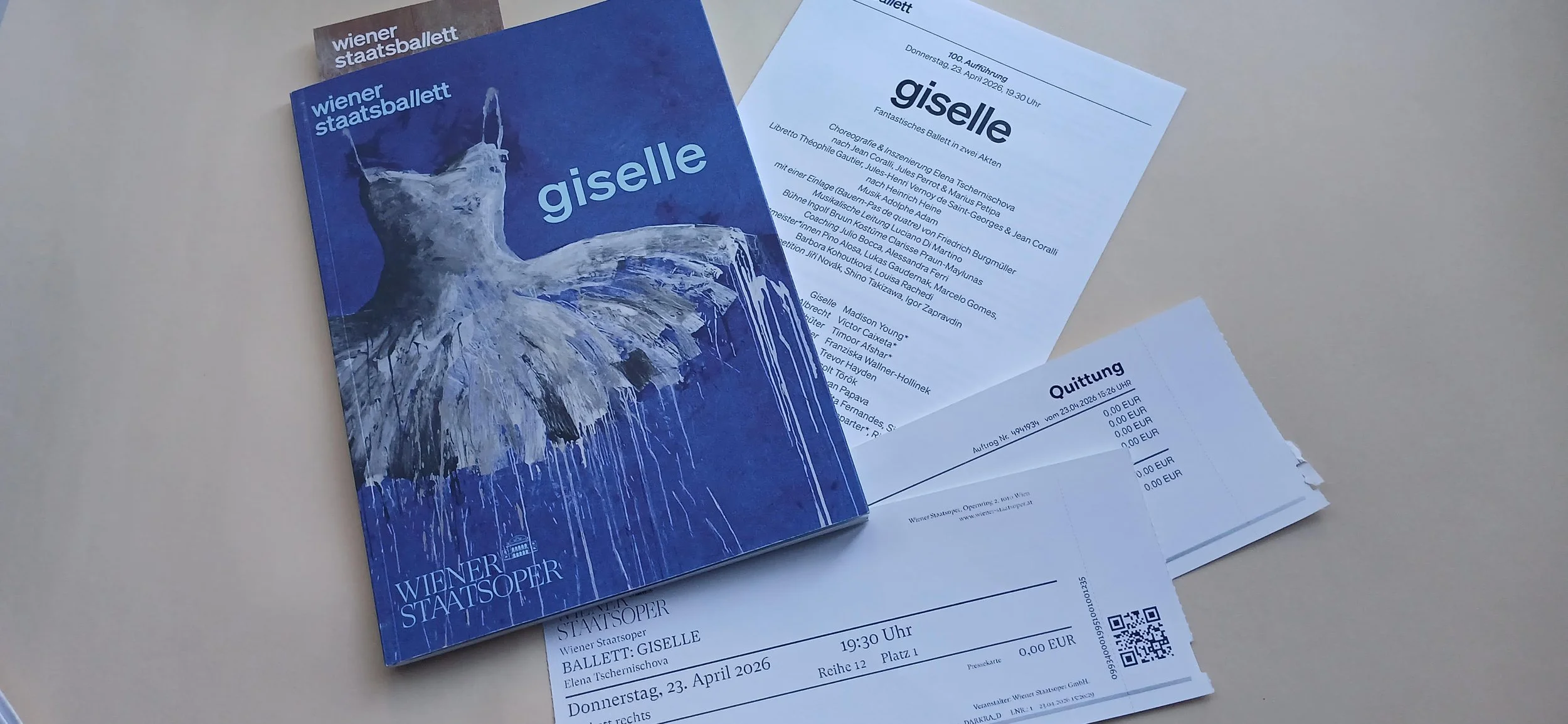
A comment on my last critique (Giselle) that was written at 1.000 mts altitude and made me very happy. It feels good to read that!
I got this comment today on my last critique... I can only say: I feel like 3,5 meters tall… Thank you, Mag. Leonhard Stadler!

Ricardo Leitner’s text on Giselle is far more than a conventional review; it reads like the testimony of someone who has lived within the art form for many years and now witnesses a rare alignment of artistic vision, institutional renewal, and individual performance. Its weight lies not only in its considerable knowledge, but in its perspective: Leitner writes from within a historical continuum, recalling past casts, earlier standards and shifting aesthetics — measuring the present not against abstract ideals, but against lived experience.
At its core is an almost philosophical reflection on transition. By drawing a parallel between a dancer’s daily physical reconstruction and a director’s ongoing reshaping of artistic vision, he reframes the performance as the visible surface of a continuous process. In doing so, he implicitly credits Alessandra Ferri with something not yet fully quantifiable: the reactivation of artistic coherence within a system, marked by inertia and artistic stagnation over the past years. His remark on Vienna’s tendency to lag behind modern developments is thus more than ironic; it sharpens the sense that what is happening now is both overdue and, for that very reason, especially meaningful.
This leads to one of the most revealing aspects of his critical language: his insistence on “style” as a central value. For Leitner, style is not decorative but structural — the invisible thread binding individual performances into a coherent whole.
At the same time, his attention returns to the question of presence: what it means for a dancer not merely to execute steps, but to inhabit a role in a way beyond technique.
His description of Victor Caixeta’s Albrecht is particularly telling. The moment in which Albrecht “feels” Giselle without seeing her is no spectacular choreographic event; it is a fragile, almost invisible, but perceptible detail, for all those who are receptive to it. Leitner elevates it to the core of the performance, as it exemplifies what he values most: the ability to render inner states legible without exaggeration.
A similar depth appears in his reading of Milda Luckutė’s Myrtha. Rather than accepting the conventional portrayal of cold authority or vengeance, he reconstructs her symbolic and psychological background, even tracing the etymology of her name to the myrtle and its associations with purity. This is not merely decorative; it supports his argument that the role, properly understood, resists simplification.
Perhaps most compelling is the review’s emotional tone. Leitner does not conceal his enthusiasm — he insists on it. But this is anything but naive: it is grounded in comparison, memory, and the rare experience of genuine surprise after many years of similar performances. When he calls the evening “a night to remember,” it does not sound formulaic—it carries the weight of someone who has seen many nights ... that were not.